
Call us 24/7+91-9867228252
PAVAN ELECTRO SOURCE: “Empowering Innovation Through Electronics, Education & Technology”
Call us 24/7+91-9867228252

🧤 Smart Sign Language Gloves using MPU6050, Flex Sensors & DFPlayer


🔍 Project Overview

This project is a Smart Sign Language Translation Glove designed to help non-speaking or speech-impaired people communicate easily. The system uses flex sensors and an MPU6050 motion sensor to detect hand gestures and finger movements used in sign language.

When a user performs a specific hand gesture, the sensors send data to the microcontroller (Arduino Nano/Arduino Uno). The microcontroller processes the gesture and converts it into a predefined message.

The translated message is then played as audio through a speaker using the DFPlayer Mini module, allowing other people to understand the user’s communication in local spoken language.

This wearable system acts as a real-time sign language interpreter, bridging the communication gap between speech-impaired individuals and normal speakers.


⚙️ How It Works (Short & Simple)

🧤 Gesture Detection
Flex sensors attached to the fingers detect bending of fingers, while the MPU6050 sensor detects hand orientation and motion.

📡 Sensor Data Processing
The sensor data is sent to the Arduino microcontroller, which analyzes the gesture pattern.

🧠 Gesture Recognition
The Arduino program compares the detected gesture with predefined sign language gestures stored in the system.

🔊 Audio Output Generation
Once a gesture is recognized, the Arduino sends a command to the DFPlayer Mini module.

🎵 Voice Playback
The DFPlayer plays the corresponding audio message through the speaker in the local language.

Example translations:

  • 🤚 Hand gesture → “Hello”
  • ✋ Gesture → “I need help”
  • 👋 Gesture → “Thank you”

🛠️ Hardware Used

  • Arduino Nano / Arduino Uno
  • MPU6050 Gyroscope & Accelerometer
  • Flex Sensors (4–5 pieces)
  • DFPlayer Mini MP3 Module
  • Speaker
  • Micro SD Card (for audio files)
  • Gloves
  • Resistors
  • Jumper Wires
  • Battery Power Supply

✨ Key Features

✔ Wearable smart communication glove
✔ Converts sign language gestures into voice output
✔ Uses flex sensors to detect finger bending
✔ Uses MPU6050 to detect hand motion and orientation
Audio output in local language using DFPlayer Mini
✔ Portable and easy-to-use assistive device
✔ Low-cost solution for speech-impaired communication
✔ Real-time gesture recognition


📈 Applications

🧏 Assistive technology for speech-impaired people
🏥 Healthcare communication devices
🎓 Research in human-computer interaction
🤖 Gesture recognition systems
📚 Educational electronics and robotics projects
🌍 Sign language translation systems


🚀 Future Scope

📱 Add mobile app for text display and translation
🌐 Integrate IoT cloud-based translation system
🧠 Use AI and machine learning for better gesture recognition
🌍 Support multiple languages
📺 Add OLED display for text output
🎤 Convert gestures into real-time speech synthesis


👍 Advantages

✔ Helps speech-impaired individuals communicate easily
✔ Portable and wearable device
✔ Real-time voice output
✔ Low-cost and scalable design
✔ Easy to upgrade with AI and IoT technologies
✔ Improves accessibility and social interaction


⚠️ Precautions

⚠️ Ensure flex sensors are properly placed on fingers
⚠️ Protect electronic components from sweat or moisture
⚠️ Use proper power regulation for sensors and modules
⚠️ Secure wiring to prevent damage during hand movement
⚠️ Calibrate sensors for accurate gesture detection
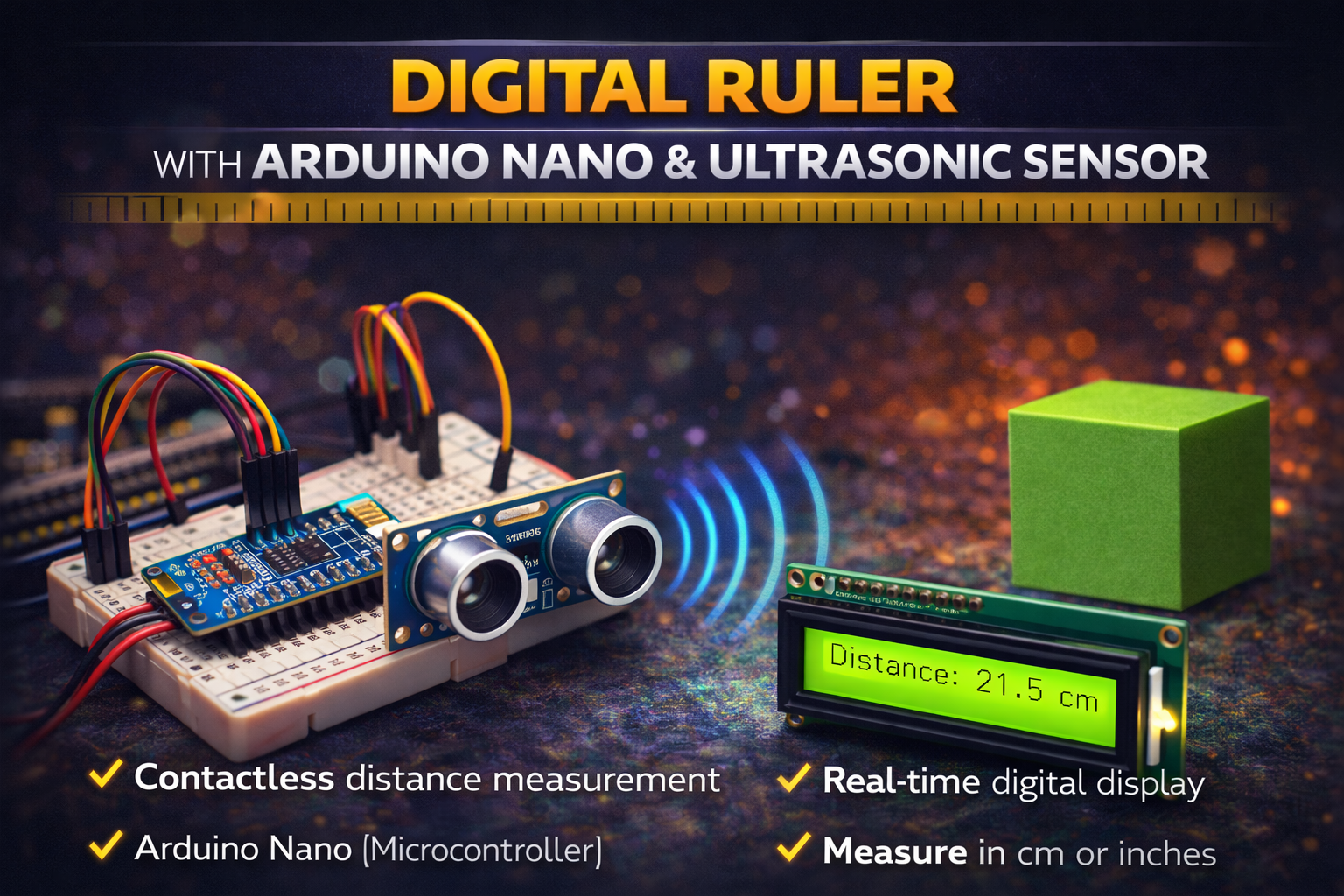
📏 Digital Ruler using Arduino Nano & Ultrasonic Sensor


🔍 Project Overview

This project is a Digital Ruler (Distance Measurement System) built using an Arduino Nano and an ultrasonic sensor. The system measures the distance between the sensor and an object and displays the measured value digitally.

The ultrasonic sensor emits sound waves, which travel through the air and bounce back after hitting an object. The Arduino calculates the time taken for the echo to return and converts it into distance in centimeters or inches.

The measured distance can be displayed on a 16×2 LCD display or sent to the Serial Monitor for real-time measurement. This project acts as a contactless digital ruler, making distance measurement fast and accurate.


⚙️ How It Works (Short & Simple)

📡 Ultrasonic Signal Transmission
The ultrasonic sensor sends out high-frequency sound waves through the Trig pin.

🔁 Echo Detection
When the waves hit an object, they reflect back and are received by the Echo pin of the sensor.

Time Calculation
The Arduino Nano measures the time taken for the sound wave to return.

📐 Distance Calculation
Using the speed of sound, the Arduino converts the time into distance using a formula.

🖥 Display Output
The calculated distance is shown on a 16×2 LCD display or the Arduino Serial Monitor.


🛠️ Hardware Used

  • Arduino Nano
  • Ultrasonic Sensor (HC-SR04)
  • 16×2 LCD Display (Optional)
  • Potentiometer (for LCD contrast)
  • Breadboard
  • Jumper Wires
  • USB Cable / 5V Power Supply

✨ Key Features

✔ Contactless digital distance measurement
✔ High accuracy using ultrasonic technology
✔ Controlled by Arduino Nano microcontroller
✔ Real-time distance display
✔ Simple and low-cost electronic project
✔ Compact and portable measuring system
✔ Easy to expand with display or wireless modules


📈 Applications

📏 Digital measuring tool
🤖 Robotics obstacle detection
🚗 Parking distance measurement systems
🏭 Industrial distance monitoring
🎓 Educational electronics projects
📦 Object distance and positioning systems


🚀 Future Scope

📱 Add Bluetooth module for smartphone display
📊 Integrate OLED display for better graphics
🔊 Add buzzer alert for minimum distance warning
📡 Connect to IoT cloud monitoring system
🎯 Improve accuracy using advanced sensors
📐 Add unit switching (cm / inch) button


👍 Advantages

✔ Non-contact distance measurement
✔ Fast and accurate readings
✔ Low power consumption
✔ Easy to build and program
✔ Affordable components
✔ Suitable for beginners and students


⚠️ Precautions

⚠️ Keep the ultrasonic sensor facing the object directly
⚠️ Avoid obstacles that absorb sound waves
⚠️ Ensure stable 5V power supply
⚠️ Do not block the sensor transmitter and receiver
⚠️ Maintain proper wiring connections to prevent errors

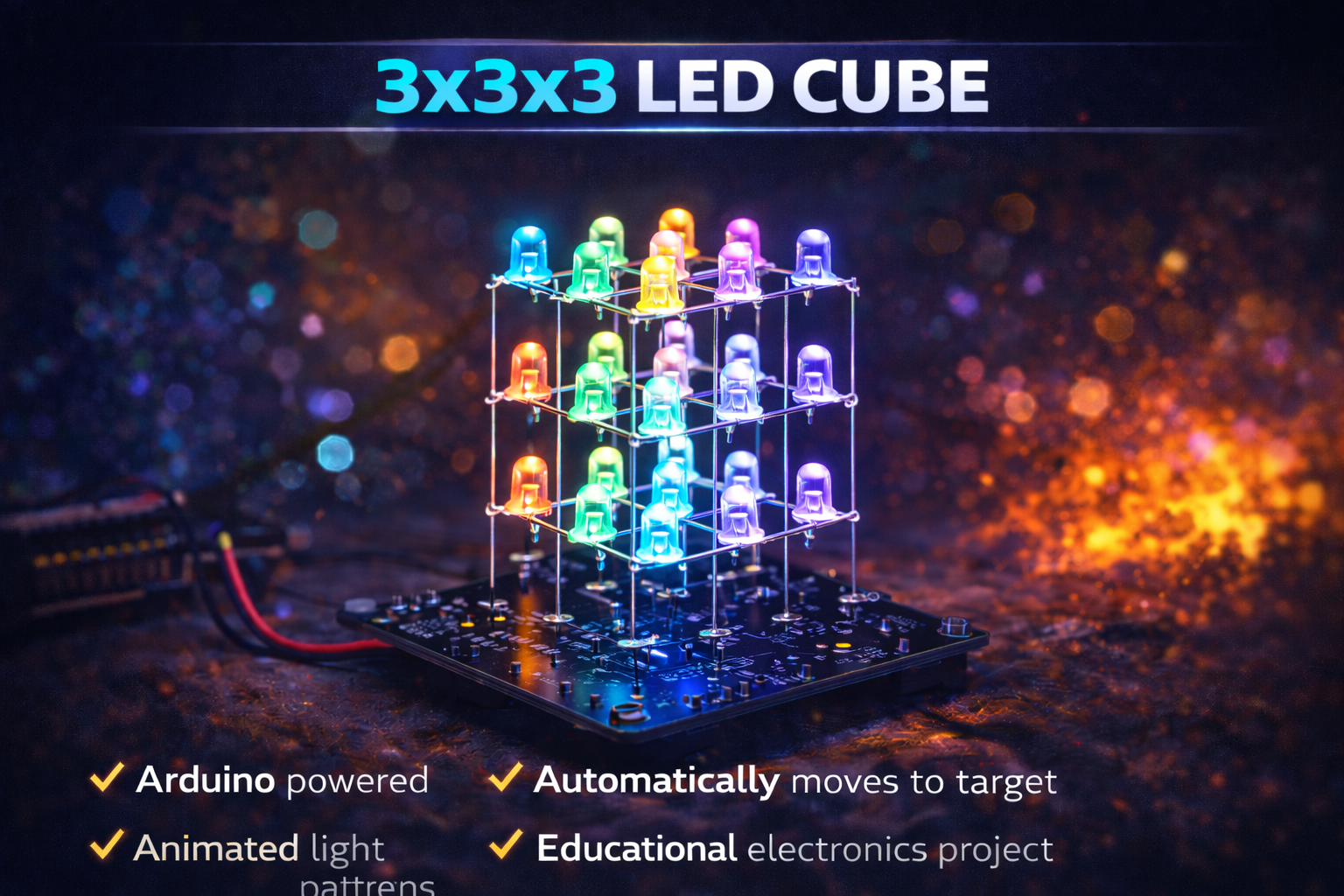
💡 3×3×3 LED Cube using Arduino Nano


🔍 Project Overview

This project is a 3×3×3 LED Cube built using 27 LEDs arranged in a cubic structure and controlled by an Arduino Nano microcontroller. The cube creates dynamic lighting patterns and animations by controlling individual LEDs through multiplexing techniques.

Each layer of LEDs is controlled independently, allowing the system to generate 3D lighting effects such as waves, blinking layers, rotating lights, and random patterns.

The Arduino Nano acts as the brain of the system, sending signals to the LEDs in rapid sequences to create visually appealing animations.

This project is widely used for learning microcontrollers, LED control techniques, and basic electronics design.


⚙️ How It Works (Short & Simple)

📱 Microcontroller Control
The Arduino Nano controls all LEDs by sending digital signals to different LED columns and layers.

💡 3D LED Structure
The cube contains 27 LEDs arranged in:

  • 3 Rows
  • 3 Columns
  • 3 Vertical Layers

This creates a 3×3×3 cube structure.

🔌 Multiplexing Technique
Instead of controlling all LEDs individually, the system activates layers one at a time very quickly, making it appear that multiple LEDs are glowing simultaneously.

🎇 LED Animation Patterns
The Arduino program generates different lighting effects such as:

  • Layer-by-layer blinking
  • Vertical light movement
  • Random LED patterns
  • Wave animations
  • Cube rotation effects

Power Supply
The cube is powered through the Arduino Nano via USB or an external 5V power supply.


🛠️ Hardware Used

  • Arduino Nano (Microcontroller)
  • LEDs (27 pieces)
  • Resistors (220Ω or 330Ω)
  • NPN Transistors (for layer control)
  • Breadboard / PCB
  • Connecting Wires
  • USB Power Supply
  • Soldering materials

✨ Key Features

✔ 3D LED cube structure with 27 LEDs
✔ Controlled using Arduino Nano microcontroller
✔ Generates multiple LED animation patterns
✔ Uses multiplexing technique for efficient control
✔ Compact and visually attractive electronic project
✔ Excellent beginner-friendly microcontroller project
✔ Can be expanded for larger LED cubes


📈 Applications

📚 Electronics learning project
🤖 Microcontroller programming practice
💡 Decorative LED lighting system
🎓 Engineering and robotics demonstrations
🧪 Educational STEM projects
🖥️ LED animation experiments


🚀 Future Scope

📡 Add Bluetooth control using HC-05 module
📱 Create a mobile app to control LED patterns
🎵 Sync cube lights with music using sound sensors
🌈 Upgrade to RGB LEDs for colorful animations
📊 Add custom pattern control through PC software
🔆 Expand to 4×4×4 or 8×8×8 LED cube systems


👍 Advantages

✔ Simple and low-cost electronics project
✔ Helps understand multiplexing and LED matrices
✔ Improves Arduino programming skills
✔ Visually attractive lighting effects
✔ Compact and portable design
✔ Easy to modify and expand


⚠️ Precautions

⚠️ Use proper current-limiting resistors for LEDs
⚠️ Ensure correct LED polarity while assembling the cube
⚠️ Avoid short circuits during soldering
⚠️ Secure the LED structure properly to prevent bending
⚠️ Do not exceed the Arduino Nano current limits

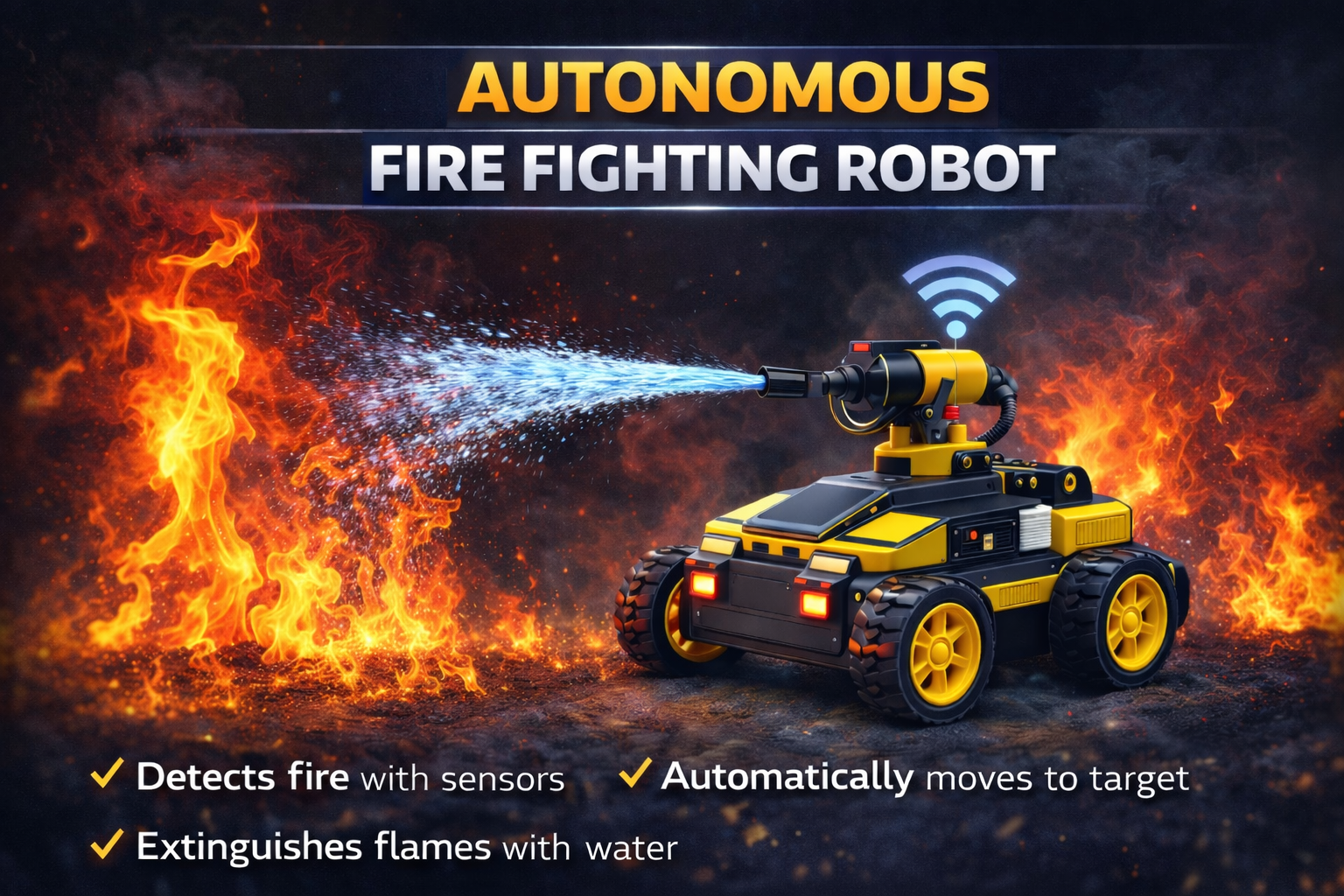
🔥 Autonomous Fire Fighting Robot


🔍 Project Overview

This project is an Autonomous Fire Fighting Robot designed to automatically detect and extinguish fire in small environments such as rooms, laboratories, warehouses, and industrial areas. The system is built using an Arduino Uno, flame sensors, DC motors, a servo motor, and a water pump mechanism.

The robot continuously monitors its surroundings using multiple flame sensors placed at different directions (left, right, and forward). When fire is detected, the robot automatically moves toward the flame source and activates the extinguishing system.

A servo motor rotates the water nozzle while the pump sprays water to suppress the fire. Once the fire is extinguished, the robot stops and resumes monitoring the environment.


⚙️ How It Works (Short & Simple)

🔎 Fire Detection

Three flame sensors detect fire in different directions:

• Left sensor
• Right sensor
• Forward sensor

These sensors send signals to the Arduino Uno.


🤖 Robot Navigation

Two DC motors controlled through motor driver pins allow the robot to move:

• Forward
• Left
• Right
• Stop

The robot moves toward the detected flame direction.


🎯 Target Alignment

If the forward sensor detects fire, the robot moves straight toward the flame source.

If the left or right sensor detects fire, the robot turns in that direction.


💧 Fire Extinguishing System

Once the robot reaches the fire source:

• The water pump activates.
• The servo motor rotates the nozzle.
• Water is sprayed across the flame area.

This sweeping motion increases the extinguishing coverage.


🛑 Fire Suppression Complete

When the fire is extinguished:

• The pump turns OFF
• The servo returns to center position
• The robot stops and resumes monitoring


🛠️ Hardware Used

• Arduino Uno
• Flame Sensors (3x)
• Servo Motor
• Water Pump
• DC Gear Motors (2x)
• Motor Driver Module
• Robot Chassis with wheels
• Battery Power Supply
• Jumper Wires
• Water Tank


✨ Key Features

✔ Automatic fire detection system
✔ Autonomous robot navigation
✔ Multi-direction flame sensing
✔ Servo-controlled water spray nozzle
✔ Automatic water pump activation
✔ Compact robotic fire suppression system
✔ Low-cost safety robotics project
✔ Continuous environmental monitoring


📈 Applications

• Industrial fire safety systems
• Warehouse fire monitoring
• Laboratory safety robots
• Home fire detection prototypes
• Robotics and automation research
• Educational robotics projects
• Smart building safety systems


🚀 Future Scope

• Add ESP32-CAM for live fire monitoring
• IoT-based fire alert system
• GSM notification system for emergencies
• Autonomous indoor navigation using sensors
• Smoke and gas detection integration
• Fire alarm integration with smart systems


👍 Advantages

• Rapid fire detection and response
• Reduces human risk during fire incidents
• Automatic extinguishing system
• Low-cost robotic safety solution
• Portable and lightweight design
• Easy to upgrade with IoT technologies


⚠️ Precautions

• Ensure proper insulation for water pump wiring
• Use stable battery power for motors and pump
• Keep electronic components protected from water leakage
• Regularly test flame sensors for accuracy
• Avoid using near high-voltage equipment
• Ensure water tank is filled before operation

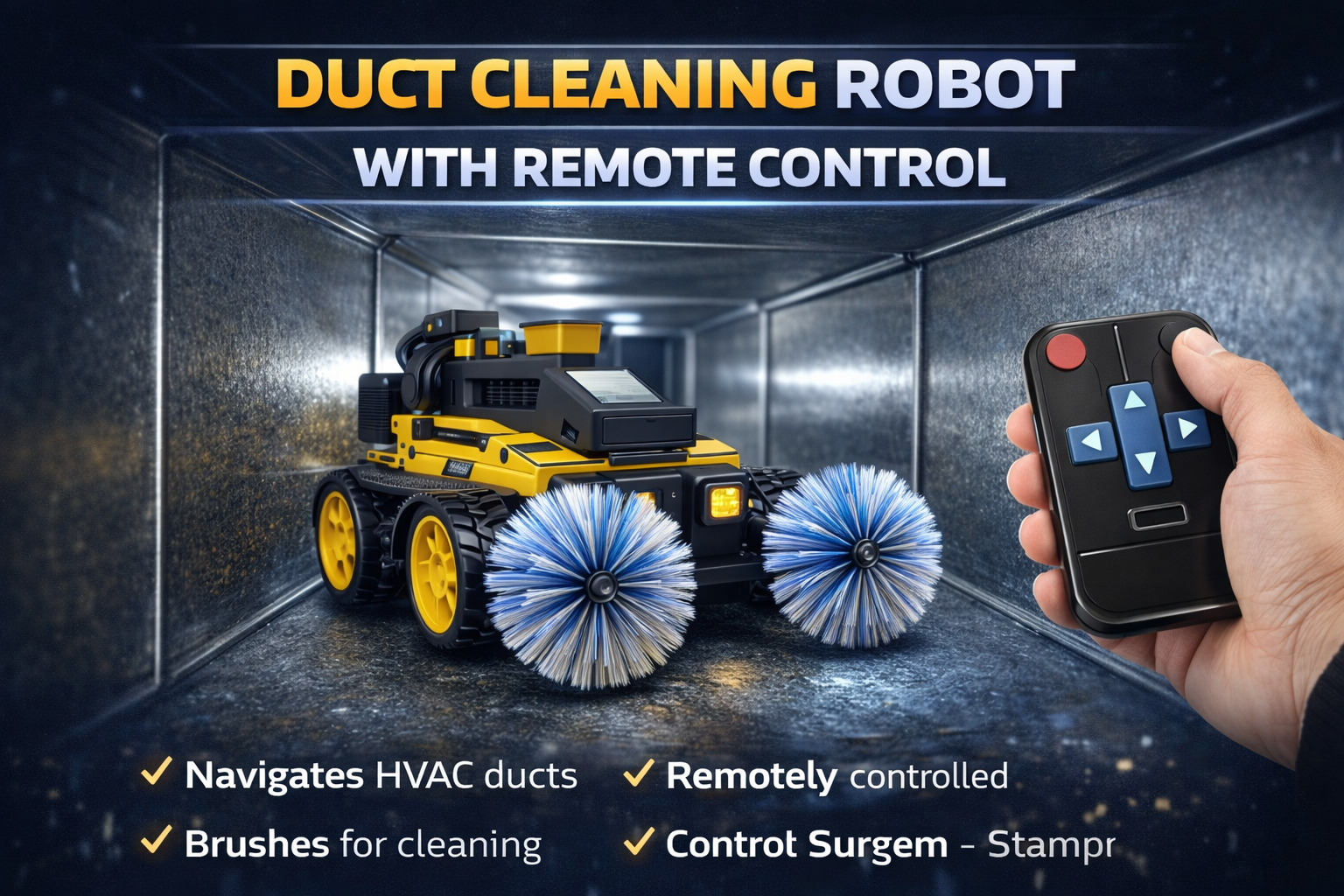
🧹 Duct Cleaning Robot with Remote Control

🔍 Project Overview

This project is a Duct Cleaning Robot with Remote Control designed to clean ventilation ducts, pipelines, and narrow industrial passages where manual cleaning is difficult or unsafe. The system is built using an Arduino Uno, motor driver modules, DC motors, and directional control switches.

The robot can be controlled using push-button commands that allow the operator to navigate the robot inside ducts and confined spaces. By pressing directional buttons, the robot moves forward, backward, left, or right to reach dust accumulation areas.

The robotic platform can also include rotating brushes or cleaning attachments to remove dust, debris, and contaminants from HVAC duct surfaces while moving through the pipeline.


⚙️ How It Works (Short & Simple)

🎮 Remote Control Operation

Directional push buttons send control signals to the Arduino Uno, allowing the operator to control robot movement inside the duct.

🤖 Robot Movement

Two DC motors controlled through motor driver pins allow the robot to move:

• Forward
• Backward
• Left
• Right
• Stop

🧭 Navigation in Ducts

The robot moves inside HVAC ducts and pipelines using wheels designed to travel through narrow and confined spaces.

🧹 Cleaning Mechanism

Rotating brushes or cleaning attachments mounted on the robot help remove dust, debris, and particles from duct surfaces.

⚡ Control Signal Processing

The microcontroller continuously reads button inputs using digital signals and activates motor outputs accordingly.

🛑 Safety Stop

If no control button is pressed, the robot automatically stops to prevent accidental movement.


🛠️ Hardware Used

• Arduino Uno
• Motor Driver Module
• DC Gear Motors (2x)
• Robot Chassis with wheels
• Push Button Remote Controller
• Cleaning Brush Mechanism
• Battery Power Supply
• Jumper Wires
• Breadboard (for testing)


✨ Key Features

✔ Remote controlled duct cleaning robot
✔ Compact design for narrow pipelines and ducts
✔ Four-direction movement control
✔ Simple and reliable Arduino-based system
✔ Low-cost inspection and cleaning solution
✔ Easy to upgrade with cameras or sensors
✔ Suitable for industrial maintenance tasks
✔ Lightweight robotic platform


📈 Applications

• HVAC duct cleaning systems
• Industrial pipeline inspection
• Ventilation maintenance robots
• Hazardous environment inspection
• Robotics and automation research
• Educational robotics projects
• Dust and debris removal in confined spaces


🚀 Future Scope

• Add ESP32-CAM for live video monitoring
• Wireless control using Bluetooth or WiFi modules
• Obstacle detection using ultrasonic sensors
• Automatic navigation inside ducts
• Dust suction or vacuum cleaning mechanism
• IoT monitoring system for remote inspection


👍 Advantages

• Reduces manual cleaning effort in ducts
• Improves worker safety in confined spaces
• Low-cost robotic cleaning solution
• Simple and reliable control system
• Portable and lightweight design
• Expandable with sensors and cameras


⚠️ Precautions

• Ensure proper battery voltage for motor operation
• Secure all wiring connections before operation
• Avoid operating in extremely wet environments
• Regularly clean brush mechanisms to maintain efficiency
• Check motor driver temperature during long operation
• Ensure proper ventilation inside ducts during operation

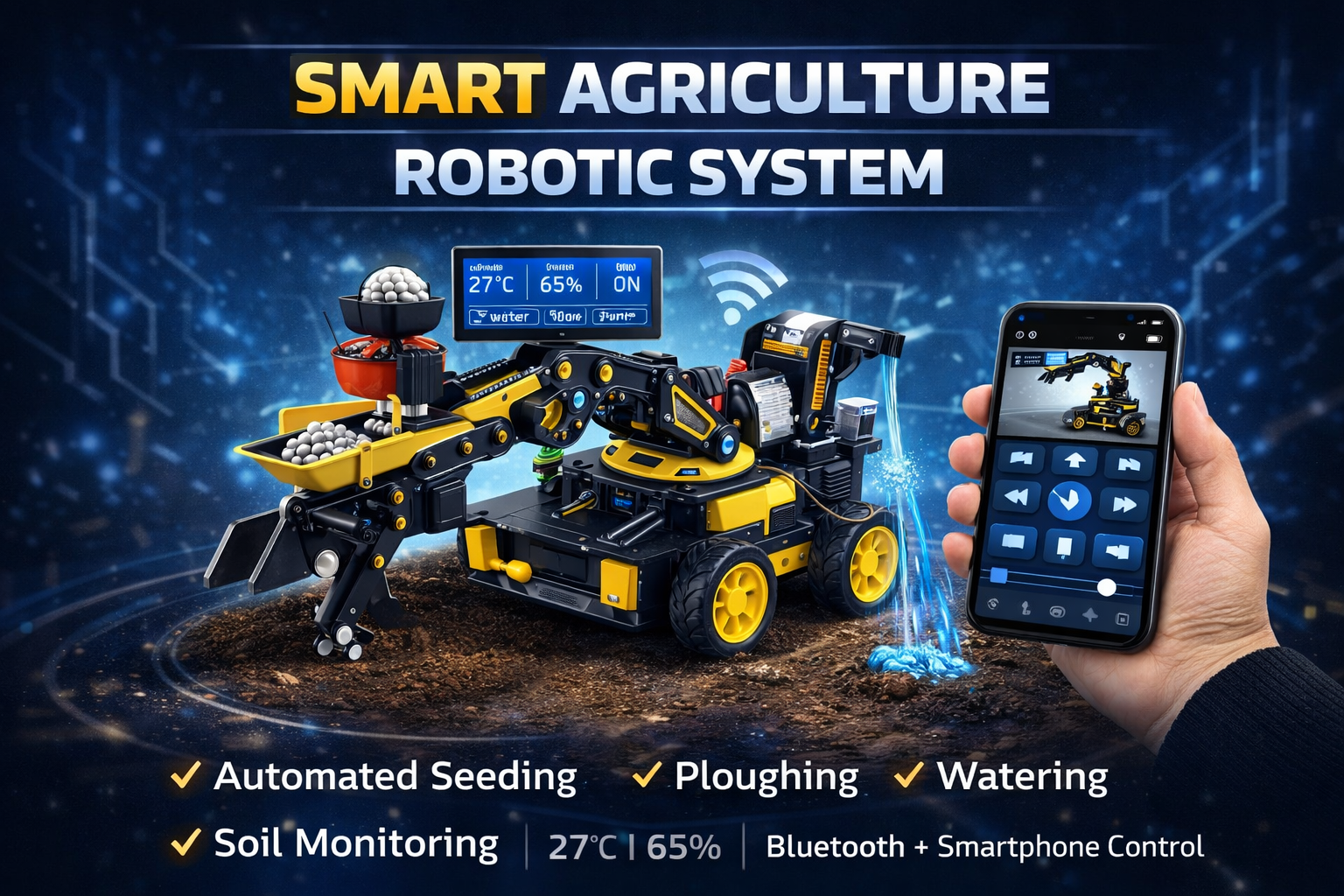
🌾 Smart Agriculture Robotic System


🔍 Project Overview

This project is an automated Smart Agriculture Robot designed to assist farmers with multiple farming tasks such as ploughing, seeding, watering, and soil monitoring. The system is built using an Arduino Uno, environmental sensors, servo mechanisms, and a Bluetooth communication interface.

The robot can be remotely controlled through a smartphone application via an HC-05 while also monitoring environmental parameters such as temperature, humidity, and soil moisture.

The collected data is displayed on a 16×2 LCD display, and automatic watering is activated when soil moisture levels drop below the safe threshold.


⚙️ How It Works (Short & Simple)

Mobile App Control
A smartphone sends commands like *forward, *Water, *Seed, etc., via Bluetooth to control robot movement and farming operations.

Robot Movement
Two DC motors controlled through motor driver pins allow the robot to move:

  • Forward
  • Backward
  • Left
  • Right
  • Stop

Ploughing Mechanism
A servo motor lowers and lifts the ploughing tool to prepare the soil.

Seed Dispensing
Another servo controls the seed container, dropping seeds into the ploughed soil.

Watering System
A water pump and servo sprinkler irrigate crops when triggered manually or automatically.

Environmental Monitoring
A DHT11 measures temperature and humidity, while a soil moisture sensor monitors soil conditions.

Automatic Irrigation
If soil moisture is low, the system automatically activates the water pump.

Data Display & Transmission
Sensor data is displayed on the LCD and transmitted to the mobile device through Bluetooth.


🛠️ Hardware Used

  • Arduino Uno
  • HC-05
  • DHT11
  • Soil Moisture Sensor
  • 16×2 LCD Display (I2C)
  • Water Pump
  • Servo Motors (4x)
  • DC Gear Motors (2x)
  • Motor Driver Module
  • Robot Chassis with wheels
  • Battery Power Supply
  • Jumper Wires & Breadboard

✨ Key Features

✔ Multi-functional farming robot
✔ Remote control via Bluetooth smartphone app
✔ Automatic irrigation based on soil moisture
✔ Temperature and humidity monitoring
✔ LCD real-time data display
✔ Integrated ploughing and seeding mechanism
✔ Low-cost smart farming solution
✔ Compact robotic platform


📈 Applications

Smart farming automation
Precision agriculture research
Agricultural robotics demonstration
Educational robotics projects
Farm monitoring systems
Small-scale crop automation
IoT agriculture prototypes


🚀 Future Scope

GPS-based autonomous navigation
IoT cloud monitoring dashboard
AI-based crop health monitoring
Solar-powered robotic farming system
Camera-based crop detection
Mobile app with live data dashboard
Automatic path planning for field coverage


👍 Advantages

Reduces manual farming effort
Improves irrigation efficiency
Real-time environmental monitoring
Low-cost agricultural automation
Portable and scalable system
Easy to upgrade with IoT features


⚠️ Precautions

Ensure stable power supply for motors and pump
Protect electronic components from water exposure
Use proper insulation for field operation
Avoid overloading the pump motor
Regularly clean soil sensors for accurate readings

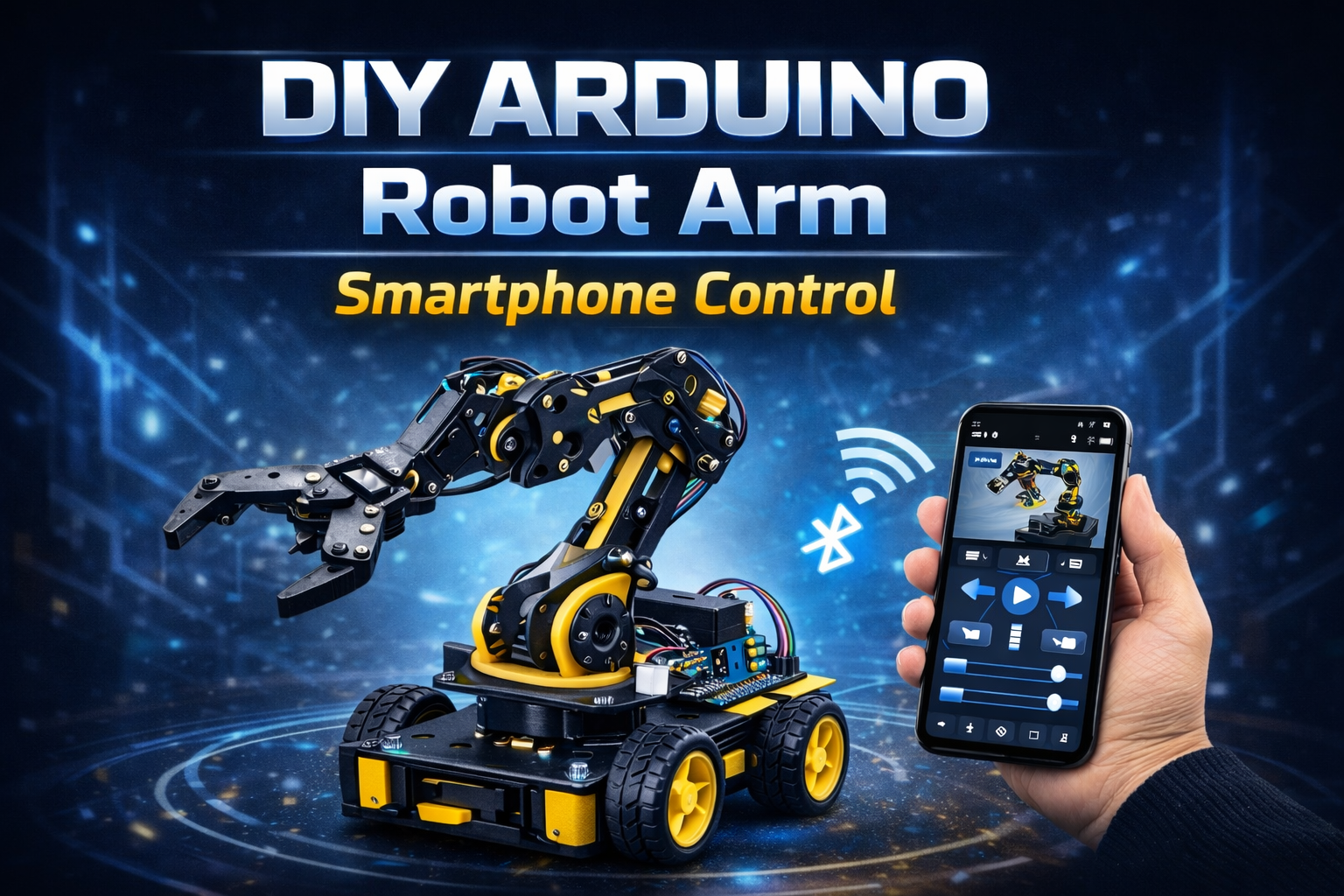
🤖 Arduino Robot Arm – Bluetooth Smartphone Control


🔍 Project Overview

This project uses an Arduino Uno, an HC-05 Bluetooth module, and a custom Android smartphone app to control a 6-DOF robotic arm wirelessly.

Each servo motor is controlled individually through sliders in the mobile app. The system also supports saving multiple movement positions and replaying them automatically in sequence.

The robot arm operates fully offline via Bluetooth communication.


📱 Bluetooth App Name

You can use apps like:

  • Arduino Bluetooth Controller
  • Bluetooth Electronics (Keuwlsoft)
  • Custom MIT App Inventor App

If you want branding for your website project section, recommended name:
“RoboArm BT Control”


⚙️ How It Works (Short & Simple)

Bluetooth Connection
Smartphone connects to HC-05 module via Bluetooth (38400 baud rate).

App Sends Commands
Each slider sends data like:

  • s1XXX → Servo 1 position
  • s2XXX → Servo 2 position
  • up to s6XXX

Smooth Servo Movement
Arduino gradually moves servos using incremental loops for smooth motion.

Save Positions
Press SAVE → stores all 6 servo angles into arrays.

Run Automatic Mode
Press RUN → replays saved steps continuously.

Pause / Reset

  • PAUSE → temporary stop
  • RESET → clears memory

🛠️ Hardware Used

  • Arduino Uno
  • HC-05
  • 6x Servo Motors (MG996R / SG90 depending on load)
  • Robot Arm Acrylic / Metal Frame
  • External 5–6V Servo Power Supply
  • Breadboard & Jumper Wires
  • Android Smartphone

✨ Key Features

✔ 6 Degrees of Freedom (6 DOF)
✔ Individual servo slider control
✔ Smooth speed-controlled motion
✔ Save & replay movement sequences
✔ Adjustable movement speed
✔ Fully offline Bluetooth control
✔ Expandable for automation


📈 Applications

Pick and place prototype
Industrial automation demo
Robotics learning project
STEM education
Small object manipulation
Assembly line simulation
Research experiments


🚀 Future Scope

Wi-Fi control using ESP32
Voice control integration
AI object detection + auto pick
Camera-based vision system
Mobile app UI improvement
Cloud-based movement storage
Gesture control using accelerometer


👍 Advantages

Low-cost build
Wireless control
Easy to program
Expandable system
Good for beginners & advanced robotics students
Real-time manual + automatic control


⚠️ Precautions

Use separate power supply for servos
Do not power servos directly from Arduino 5V
Avoid sudden load on arm joints
Secure mechanical screws properly
Ensure correct Bluetooth pairing
Prevent overheating during long runs

The Arduino Explorer: Smart Obstacle-Avoiding Robot 

🔍 Project Overview

The Arduino Explorer is an intelligent robotic car powered by the versatile Arduino Uno R3. It autonomously navigates its environment using smart sensor technology to detect and avoid obstacles. This project is ideal for beginners and enthusiasts stepping into robotics, programming, and automation with Arduino.


⚙️ How It Works (Short & Simple)

Sensing (The Eyes)
The HC-SR04 Ultrasonic Sensor, mounted on a servo motor, continuously emits sound waves and measures the time for them to return, acting as the robot’s eyes.

Scanning
The SG90 / MG90S Servo Motor pivots the sensor left and right, giving the robot a wide field of view to identify the clearest path.

Decision Making (The Brain)
The Arduino Uno processes distance data from the sensor. If an obstacle is detected, it decides whether to stop, reverse, or turn, ensuring safe navigation.

Action (The Movement)
Commands from the Arduino drive the L298N Motor Driver Module, which directs power from the 12V battery pack to the four DC motors, allowing the robot to move and avoid obstacles efficiently.


Key Features

✔ Arduino Uno-powered, beginner-friendly platform
✔ Intelligent obstacle avoidance
✔ Active scanning system via servo-mounted ultrasonic sensor
✔ Four-wheel drive for excellent traction and maneuverability
✔ Fully autonomous navigation


🛠️ Core Components

• Brain: Arduino Uno R3
• Chassis: 4-Wheel Robot Platform
• Propulsion: 4 x DC Motors
• Motor Control: L298N Motor Driver Module
• Primary Sensor: HC-SR04 Ultrasonic Sensor
• Scanning Mechanism: SG90 / MG90S Servo Motor
• Power: 1 x 12V Battery Pack


📈 Applications

• Beginner robotics learning
• Obstacle avoidance practice
• Autonomous vehicle prototypes
• STEM education and DIY projects
• Indoor navigation experiments


🚀 Future Scope

• Add line-following functionality
• Integrate Bluetooth or Wi-Fi control
• Add camera for visual navigation
• Implement path planning algorithms
• Obstacle data logging and analytics


👍 Advantages

✔ Easy to program and customize
✔ Fully autonomous obstacle avoidance
✔ Compact, low-cost hardware
✔ Scalable for more sensors and features


⚠️ Precautions

• Ensure proper battery voltage and wiring
• Securely mount the sensor and servo
• Avoid exposing electronics to water or dust
• Test in a clear area to prevent damage

Search for products

Back to Top

Product Enquiry

Product has been added to your cart
Compare (0)