
🔬 Arduino Uno Trainer Kit
🔍 Project Overview
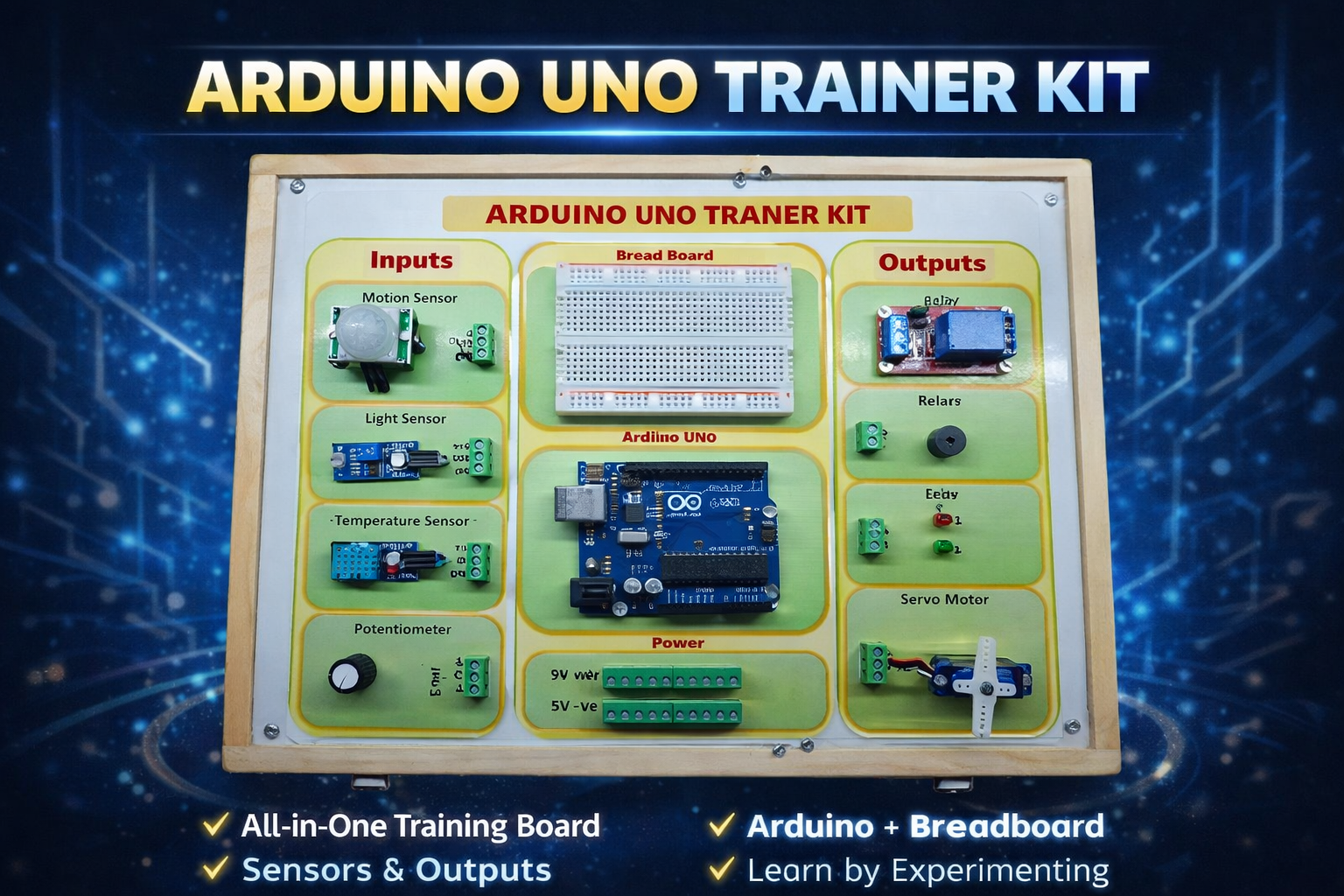
The Arduino Uno Trainer Kit is an all-in-one embedded systems learning board designed for practical experimentation with sensors and actuators. It integrates an Arduino Uno, breadboard, multiple input modules, and output devices into a single mounted training panel.
This kit allows students to understand real-time interfacing, GPIO control, analog/digital signal processing, and actuator driving without complex wiring setups.
The system is ideal for beginners, diploma/engineering students, and embedded systems training labs.
⚙️ How It Works (Short & Simple)
Power Distribution
Board provides regulated 5V and external power terminals for safe operation.
Input Section
Sensors send analog/digital signals to Arduino:
- Motion detection (PIR)
- Light intensity sensing
- Temperature measurement
- Variable resistance (Potentiometer)
Processing Unit
Arduino reads sensor data via analog/digital pins and processes logic.
Output Section
Based on program conditions, Arduino controls:
- Relay module
- Buzzer
- LEDs
- Servo motor
Breadboard Area
Allows additional circuit prototyping and expansion.
🛠️ Hardware Included
- Arduino Uno
- Breadboard
- PIR Motion Sensor
- LDR Light Sensor Module
- Temperature Sensor Module (DHT11 / LM35 type)
- Potentiometer
- Relay Module
- Buzzer
- LEDs (Red & Green)
- Servo Motor
- Power Distribution Terminals
- Mounted Wooden/Panel Base
✨ Key Features
✔ All-in-one embedded training platform
✔ Clearly separated Input & Output sections
✔ Plug-and-play wiring
✔ Safe low-voltage operation
✔ Ideal for lab demonstrations
✔ Supports analog & digital experiments
✔ Expandable via breadboard
✔ Perfect for beginners
📈 Applications
Embedded systems laboratory
Engineering practical sessions
School STEM labs
Arduino programming practice
Sensor interfacing demonstrations
Industrial training workshops
Mini project development
🚀 Future Scope
IoT integration using ESP8266/ESP32
LCD / OLED display integration
Data logging via SD card
Mobile app control via Bluetooth
Cloud dashboard integration
Automation project expansion
AI-based sensor monitoring
👍 Advantages
Compact and organized design
Reduces wiring errors
Faster experiment setup
Reusable for multiple experiments
Cost-effective training solution
Beginner-friendly architecture
⚠️ Precautions
Use correct voltage input
Avoid short circuits on breadboard
Disconnect power before rewiring
Handle sensors carefully
Do not overload relay output
Keep board in dry environment
